
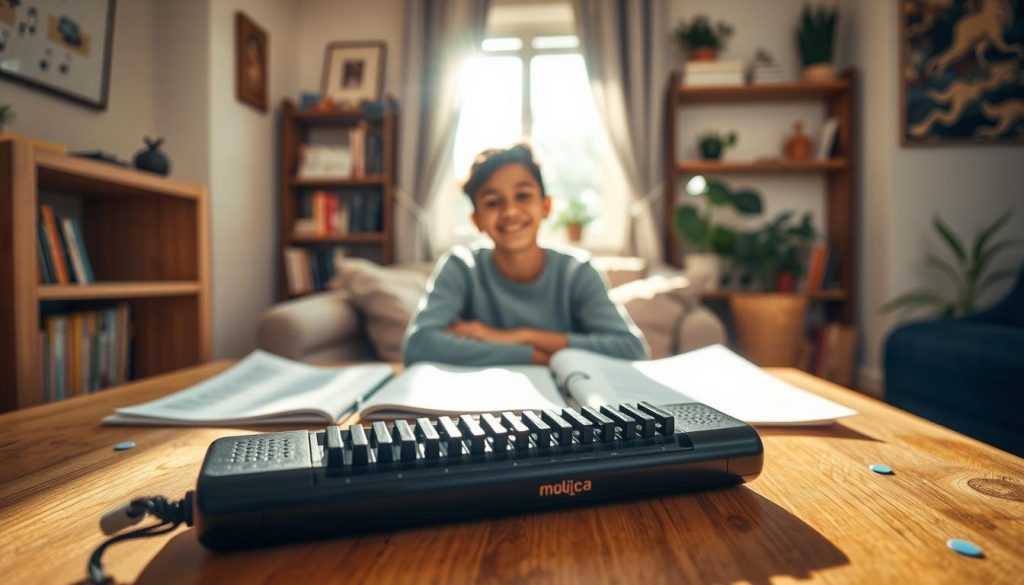
Discovering the melodica opens the door to a simple and rewarding musical practice. This instrument, similar to a small portable piano, is appealing because it is quick to learn and has a warm tone.
In just a few sessions, you can produce clear melodies and pleasing chords. Its intuitive design helps beginners and older players progress without frustration.
This guide provides clear steps for developing dexterity and a musical ear. You will learn to master the basics and adapt your playing to jazz, reggae, or the classical repertoire.
Follow a structured, practical, and progressive method. The result: greater confidence, precise musical phrases, and the pleasure of creating your own pieces.
Understanding How the Melodica Works
Understanding how air flows through the instrument clarifies your approach to playing. The melodica combines a familiar keyboard with a breath system to produce a lively, expressive sound.
Reed Mechanism
The instrument works using free reeds similar to those in a harmonica. When you blow air into it, these small metal tongues vibrate and create its tone.
Each keyboard key opens a valve that directs air toward the corresponding reed. The result is precise notes and an immediate response.
Role of the Air Tube
The tube connects your mouth to the main body. It ensures a smooth flow of air and makes playing more comfortable.
- The mechanism relies on free reeds that vibrate under air pressure.
- The keyboard is identical to a piano keyboard, making the transition easier for pianists.
- Unlike a piano, human breath shapes the tone and expression.
History and Origins of This Unique Instrument
The origins of the melodica reflect a process of technical and cultural evolution.
The story begins in the nineteenth century with prototypes such as Ch. Weiss’s Symplexophon. Jacques Reine Pâris, from Dijon, later created the harmoniphon, a key milestone in this history.
In 1908, the Hohner brand introduced the Hohnerette. This pioneering model paved the way for the instrument’s modern development.
During the twentieth century, the melodica became popular. Augustus Pablo incorporated it into reggae and changed how the public perceived it. The instrument went from a technical curiosity to a respected musical tool.
- Industrial and artisanal roots.
- Evolution toward the popular stage.
- Adoption by various musical genres.
| Period | Invention | Creator | Impact |
|---|---|---|---|
| 1870 | Symplexophon | Ch. Weiss | Mechanical prototype |
| 19th century | Harmoniphon | Jacques Reine Pâris | Conceptual foundation |
| 1908 | Hohnerette | Hohner | Standardization |
| 20th century | Modern melodica | Augustus Pablo (popularization) | Use in reggae and world music |
For further information, a dedicated page traces the history of instrument makers and prototypes, including
Jacquot and the history of the instrument.
How to Choose a Model to Learn to Play the Melodica Easily
The keyboard format and number of keys determine your musical possibilities from the outset.
Importance of the Number of Keys
For beginners, choose a model with at least 32 keys. This provides enough range for most pieces.
Models range from 26 to 44 notes. Fewer keys limit the range, while more keys increase the instrument’s size.
A 32-key melodica resembles a scaled-down piano. It offers a good balance between compactness and harmonic possibilities.
- Check the quality of the materials: a good finish ensures durability and a precise key response.
- Test the weight and grip to ensure everyday comfort.
- Consult a model comparison before purchasing.
Choosing the right instrument will make learning easier and protect your posture. Investing a little time in the selection process will make the first few weeks more enjoyable.
The Different Types of Melodicas Available
Melodicas fall mainly into two families: keyboard models and button models. Keyboard versions are the most common and reproduce the ergonomics of a piano.
A keyboard melodica can be played with the right hand playing the melody while the left hand steadies the instrument using a handle.
Placing the instrument on a table frees both of the musician’s hands. This makes it possible to form complex chords and enrich the musical texture.
Button models, often alto or soprano instruments, are manufactured by Hohner. They are designed to be played with both hands and offer a different approach from the piano.
Instrument and community come together at events such as the Melodica Festival, held in Cologne, New York, Hamburg, Sydney, and Melbourne. These gatherings celebrate the diversity of instruments and inspire musicians.
Mastering Posture and Breathing
Adopting a stable posture greatly improves breath quality and note accuracy.
Hand Position
The right hand should remain relaxed on the keyboard so that it can play the melody without tension. The left hand keeps the instrument stable and prevents unwanted movement.
Tips: keep your wrists straight and your shoulders relaxed. Holding the instrument close to your body reduces fatigue.
Breath Control
Air control determines the attack and duration of notes. Breathe deeply without forcing, and synchronize your exhalation with the music’s tempo.
Using both hands lets you explore richer chords and turn the melodica into a small, expressive piano.
- Use diaphragmatic breathing for greater endurance.
- Use short attacks for staccato notes and continuous airflow for legato notes.
- Avoid tension: it impairs tone and accuracy.
| Aspect | Goal | Quick Tip |
|---|---|---|
| Posture | Stability and comfort | Straight back, lowered shoulders |
| Right hand | Note accuracy | Relaxed fingering on the keyboard |
| Left hand | Instrument stability | Hold without squeezing |
| Breath | Dynamic control | Deep, steady breathing |
To explore teaching methods in greater depth and build a repertoire, consult dedicated training through this educational resource collection, which offers practical tips and suitable exercises.
Basic Keyboard-Handling Techniques
Working with the keyboard requires precise coordination between your breath and hand movements. Handling the keyboard demands accuracy: each key corresponds to a note that you activate with your right hand.
Press the keys evenly to produce a smooth sound. Synchronize finger pressure with the air you blow into the instrument. This method stabilizes the duration and attack of the notes.
When using the air tube, you can set the instrument down like a piano. Placing the melodica on a surface makes fast passages easier and frees both hands to play chords.
Maintain constant air pressure. Controlled breathing prevents changes in volume and allows you to produce harmonious notes throughout the piece.
Tips: practice slowly, increase your speed gradually, and repeat short patterns to improve your dexterity. These exercises strengthen muscle memory and coordination between the right and left hands.
| Aspect | Goal | Recommended Exercise |
|---|---|---|
| Coordination | Connect the keys and breath | Looped slow scales |
| Consistency | Stable sound | Metronome exercises |
| Speed | Fast passages | Gradual acceleration |
To discuss tone and discover practical tips, visit the melodica sound forum.
Developing Coordination and Musical Memory
Synchronizing your hands and breath is essential for committing musical patterns to long-term memory.
Learning music theory remains essential for reading scores and making sense of musical phrases. Understanding clefs, rhythms, and intervals helps you anticipate sequences.
Recommended practice: work on a short measure in a loop. Focus on the notes and sustaining the chords to stabilize motor memory.
Learning Music Theory
Music theory structures the learning process and facilitates group practice. By studying scores, you quickly identify harmonic and rhythmic elements.
Coordination between the hands and breath also improves cognitive abilities, as observed in pianists. This repetition strengthens neural connections associated with sounds and movements.
- Break an excerpt into short phrases.
- Repeat slowly, then increase the tempo.
- Combine visual reading with performance to improve memorization.
To learn more about the benefits and teaching approach, consult this page about reasons to play this instrument.
Tips for Regular, Long-Lasting Maintenance
Simple, regular care keeps your melodica reliable year after year. Regular maintenance is essential if your instrument is to be used for many years without any deterioration in sound quality.
Cleaning: mouthpieces should be washed in warm, soapy water, like those of other wind instruments. Dry them carefully before reattaching them.
Store the instrument in a dry, dust-free place. A hard case or cover protects its delicate internal parts.
- Prevent moisture from accumulating after each session.
- Check the condition of the reeds and valves regularly.
- Follow these tips to prevent condensation and the buildup of debris.
Any complex repair should be entrusted to a properly equipped professional. Professional servicing ensures precise tuning and safe reed adjustment.
Resources and Methods for Making Rapid Progress
Targeted resources and a consistent method will significantly accelerate your progress.
For learning, combine video tutorials, classes at a music school, and structured exercises. Videos demonstrate hand positioning and the nuances of breath control across the keyboard.
Choosing a good instrument makes daily practice easier. Platforms such as France Minéraux offer reliable models suited to beginners and experienced players alike.
Work with a variety of sheet music to explore different styles and rhythms. Beginning with simple scores and gradually moving to more complex ones strengthens sight-reading and musical memory.
Advice from teachers or experienced musicians helps you correct your posture quickly and improve your accuracy. Regular feedback prevents inefficient habits from becoming established.
- Alternate between tutorials and in-person sessions to benefit from personalized guidance.
- Choose progressively more difficult scores to structure your practice.
- Try several instrument models before investing.
- Practice regularly: consistency remains the key to rapid progress.
Conclusion
A true bridge between breath and keyboard, the melodica invites you to explore phrases and chords with precision. Its portable design and warm tone make it a valuable tool for amateur practice and stage performance.
Its history, shaped by inventors such as Jacques Reine Pâris, reflects a rich evolution within global musical culture. This journey reinforces its status as an instrument in its own right.
Mastery requires patience and discipline, but the artistic rewards are considerable. Whether you are a beginner or a professional, working on breath and keyboard technique will open up new creative perspectives in music.
We hope this guide gives you the foundation you need to begin your journey with confidence and enthusiasm today.