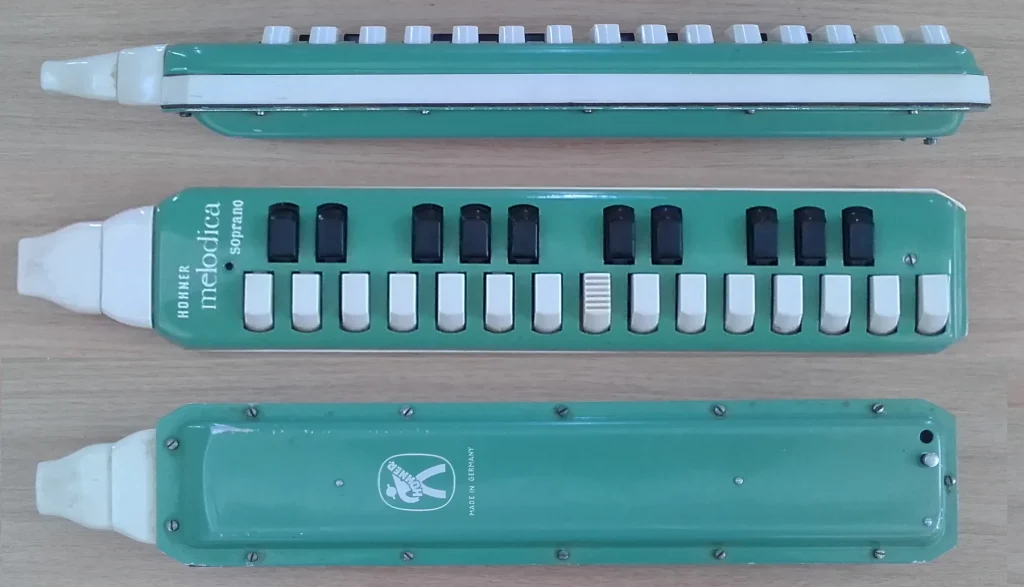
Discovering this instrument begins with understanding its history and use. In 1908, the Hohner brand launched the Hohnerette, a step that preceded the modern form of the melodica. The artist Augustus Pablo later popularized this instrument in reggae, giving it worldwide exposure.
The generic name covers various compact, portable keyboard models. They come in different sizes and ranges, often spanning from one and a half to three octaves, which influences musicians’ choices.
In practice, mastering the keys requires regular practice to achieve a consistent sound. To make the right choice, consult our guide and the detailed classification available in the model classification. Our advice will help you select a model suited to your level and intended use.
Understanding how the melodica works
Understanding how the air and keyboard work together provides a better grasp of how this instrument works.
Free-reed mechanism
The heart of the system consists of free reeds that vibrate when air passes through the body. Each key opens a valve that directs the airflow toward a dedicated reed.
The importance of breath
A steady breath ensures stable vibration and a consistent tone. The right hand plays the melody on the keyboard, while the left hand steadies the instrument and forms chords.
- Two types exist: button models and keyboard models, suitable for beginners and professionals alike.
- Using a tube makes it possible to play with both hands and explore harmonic textures.
- Each key corresponds to a reed, providing precise nuances and dynamics.
To place this mechanism in the broader context of wind instruments, see our page about the wind-instrument family.
Soprano, alto, or bass melodica: what are the differences?
Each version offers a range and ergonomics that directly influence playing technique and repertoire.
Distinctive features of the soprano model
The high register favors piercing melodic lines. Standard instruments often have around 36 keys, providing a useful range for clear solos.
Characteristics of the alto version
Tonal balance is this variant’s strength. It is well suited to accompaniment on the keyboard while retaining a strong presence in the mix.
Distinctive features of the bass register
The low register adds real depth. It makes it possible to explore low frequencies and enrich arrangements.
“The instrument’s size and number of octaves determine its place in an ensemble.”
- Hohner’s button melodicas offer another approach: playing with both hands, with the notes divided between them.
- A tube allows the instrument to be set down, freeing both hands to play chords.
- Some models imitate the shape of a saxophone, illustrating the variety of available types.
Technical criteria for choosing the right instrument
Choosing an instrument is based on simple, practical criteria. Favor a model with at least 32 keys so that you do not run out of notes in complex pieces.
The size and number of octaves determine the usable range. Versions with 3.5 octaves offer up to 44 notes, making them ideal for experienced musicians.
When buying online, check that the tube is included. It allows you to set the instrument down like a piano and play with both hands more easily.
The free-reed mechanism requires regular maintenance. Clean the instrument to prevent dust from impairing airflow and note quality.
“The right hand should be comfortable on the keyboard while the left hand provides stability.”
- Compare the models and types—button-based or shaped like a saxophone—to find the best ergonomics.
- Seek professional advice if you are unsure about the size, number of keys, or repertoire.
Conclusion
The decision depends mainly on the note range and the style of music you enjoy. Choosing among the different models means assessing their range, usable octaves, and the role the instrument will play in your arrangements.
For beginners and experienced musicians alike, the versatility of melodicas makes learning easier. A compact model may be sufficient, while a larger model offers more keyboard notes and possibilities.
Finally, maintain the instrument regularly: remove dust, clean the mouthpieces, and check the reeds. Regular practice and sound advice found online remain the best ways to improve and enjoy this instrument to the fullest.
FAQ
What is a free-reed instrument, and how does it work?
A free-reed instrument produces sound when air causes a free reed mounted in a metal plate to vibrate. Pressing a key opens a valve that directs air toward the corresponding reed, thereby creating a note. The mechanism is simple, robust, and similar to that of an accordion or harmonica, but it is mounted beneath a compact keyboard for playing melodies and chords.
Does breath have a major effect on the sound and dynamic control?
Yes. Air pressure determines the volume and attack of the notes. A gentle breath produces a soft tone, while a stronger breath increases volume and presence. Good diaphragm control makes it possible to produce nuances, legato passages, and accents without forcing the instrument.
What is the main difference between the soprano, alto, and bass models?
The variations lie in register and range. The first covers the high register and is ideal for bright melodic lines. The intermediate version offers a balance between high and low notes for accompaniment and solo playing. The low register provides deep notes for bass lines and accompaniment, with instruments that are often wider and have a sound closer to that of a piano.
Which model is best suited to playing with the right hand alone?
For right-hand-only playing, a model centered on the high or middle registers is practical. It allows you to play clear melodies without having to manage an excessively wide range. The keys generally accommodate basic piano technique, making one-handed performance easier.
Can chords be played with both hands on this instrument?
Yes. Some models offer a range of three octaves or more, which is sufficient for playing chords with both hands. A tube allows the instrument to be set down and played like a small keyboard, freeing both hands for more complex harmonies.
How do I choose a size and number of octaves suited to my level?
Beginners will appreciate a compact two- to three-octave model for learning scales and chords. Advanced musicians may prefer three octaves or more for greater range and flexibility. Consider the intended use: traveling rehearsals call for compactness, while studio or stage use favors a wider range.
Which technical criteria should I check before buying?
Check the quality of the reeds—the metal and how they are secured—the consistency of the key action, the construction of the casing, the inclusion of a tube or mouthpiece, and the dynamic response to breath. Also check the protection against dust and ease of maintenance.
Do the reeds require special maintenance?
Yes. Avoid prolonged moisture, dry the instrument after use, and store it in a case. Occasionally cleaning the air inlets and, when necessary, having a specialist adjust or replace the reeds will extend the instrument’s service life.
Is it easy to replace or adjust a faulty reed?
Depending on the model, some reeds are accessible and can be replaced by an instrument maker or technician. Access may be more complicated on inexpensive instruments. For precise adjustment, it is best to entrust the work to a professional to avoid damaging the bell or valve alignment.
Can this instrument produce a sound similar to a piano or saxophone?
Its tone remains distinctive: it is closer to a harmonica or harmonium than to a piano or saxophone. However, good reeds and proper breath control can produce a variety of tone colors and percussive attacks reminiscent of other wind instruments.
Which accessories are recommended for playing?
A hard case, a flexible tube for playing with the instrument set down, a microfiber cloth, and possibly a keyboard stand. For stage use, a dust cover and an ambient microphone improve projection.
How can I prevent dust and moisture from building up inside the instrument?
Store the instrument in a case, briefly blow air through it after use to dry the interior, and avoid damp places. A dehumidifier in the case can help in very humid climates.
Which manufacturers and models are recommended for beginners and professional use?
For beginners, brands such as Hohner offer robust, accessible models. For professional use, Yamaha and Suzuki offer more precise, durable instruments with better dynamic response and reed control.
Is the instrument suitable for children, and at what age can they start?
Children can start at around six or seven years old, depending on the size of their hands and their ability to control their breath. Lightweight, compact models make learning and handling the instrument easier.