
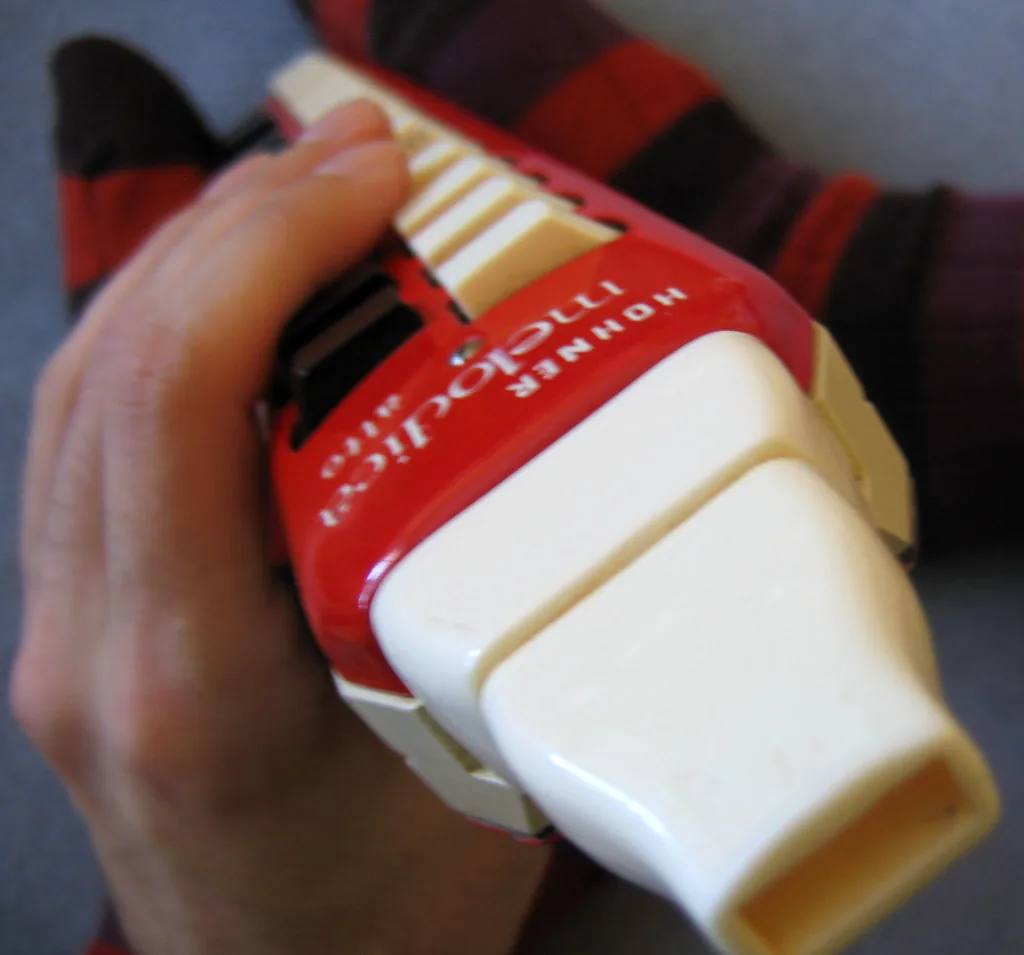
Brief overview. The name evokes a hybrid instrument that is easy to carry and capable of producing deep musical lines.
Origin and manufacturer. Hohner, a German company, has played a major role in popularizing these keyboard instruments since the mid-20th century.
It works through a keyboard that directs air toward reeds. The musician blows into a tube or mouthpiece while pressing the keys.
More than a toy, this musical instrument produces textures resembling those of the piano and harmonica. Its body, often made of plastic, provides musicians with a lightweight yet durable instrument.
Current use. It is used to play bass lines in ensembles or to broaden a sound palette. To learn more about its features and variants, see this detailed overview.
Understanding the origins and family of the melodica
To understand the melodica, we must look back at the earliest devices that used reeds to set air into vibration. This instrument belongs to the family of wind instruments, and more specifically to the free-reed instrument family, whose sound-production principle is similar to that of the harmonica.
The legacy of free-reed instruments
In 1804, Johann Nepomuk Mælzel invented the panharmonicon, a mechanical ancestor that inspired many innovations. The principle remains simple: air passes through reeds to produce vibrations. This system accounts for the melodica’s rich timbre.
The historical development of the Hohner brand
The Hohner brand, a German company, marketed the first melodica in 1958. The models evolved from devices with buttons to the modern keyboard format, which is now the most common.
- It works through the musician’s breath and the use of keys.
- The plastic construction made production affordable while ensuring good durability.
- In Asia, melodicas are often used as introductory music-education tools in schools.
For further historical information, see this detailed study of the evolution of reed instruments.
How the instrument works and how to get started
The technical principle combines controlled breath and metal reeds to produce sound. The instrument works through air directed by the musician across free reeds. The mouthpiece regulates pressure and affects the dynamics.
The modern keyboard makes the instrument easier to play. The piano keys provide true polyphony, similar to that of a small piano, and make it possible to play rich chords.
To play with both hands, a flexible tube is often used. The musician can set the instrument down and free the right hand to move across the keys, while the left hand holds the instrument or strap.
- High-quality reeds help the instrument stay in tune and provide a long service life.
- Unlike older models with buttons, the keyboard simplifies learning and encourages expressive playing.
- The Yamaha Pianica P-37D (2014) clearly demonstrates the low breath requirement and high degree of expressiveness possible in the studio.

Those interested in its use in blues or other genres can also consult blues musical instruments for ideas on incorporating it into a stage performance.
Bass melodica: what is this rare model used for in modern music?
From the concert hall to the recording studio, this instrument offers a distinctive sound palette. It enriches orchestral arrangements with low-register lines and a tone color that few other instruments can produce.
Exploring tonal nuances in the studio and on stage
In the studio, the piano keys and the keyboard’s responsiveness make it possible to record highly detailed parts. Engineers value the ability to vary the breath through the mouthpiece to obtain crisp attacks or gentle phrasing.
On stage, musicians can play with both hands: the right hand plays melodic lines, while the left hand steadies the instrument or plays chords. This technique turns the instrument into a small portable piano.
Historical examples further demonstrate its appeal. In 1966, Steve Reich recorded a work entitled “Melodica.” More recently, the Melodica Men (Joe Buono and Tristan Clarke) have popularized the instrument through viral videos since 2016.
Integration: Hohner and other manufacturers offer models designed for modern musicians. In ensembles, the reeds provide a unique texture that complements strings or wind instruments.
For more information about its history and classification, see a reference page on the melodica and a technical study of its models and variants.
Summary of how this unusual instrument is used
In short, the melodica combines expressiveness and portability for a wide range of musicians. Its operation, based on free reeds, gives it a unique tone. The keyboard and piano keys make it easier to learn and play with both hands.
Whether using a tube or a mouthpiece, the instrument remains intuitive to handle. Parts played with the right hand and left hand become more precise. Materials such as plastic provide good durability. The Hohner brand, a German company, has confirmed the enduring role of this instrument in recent years.