
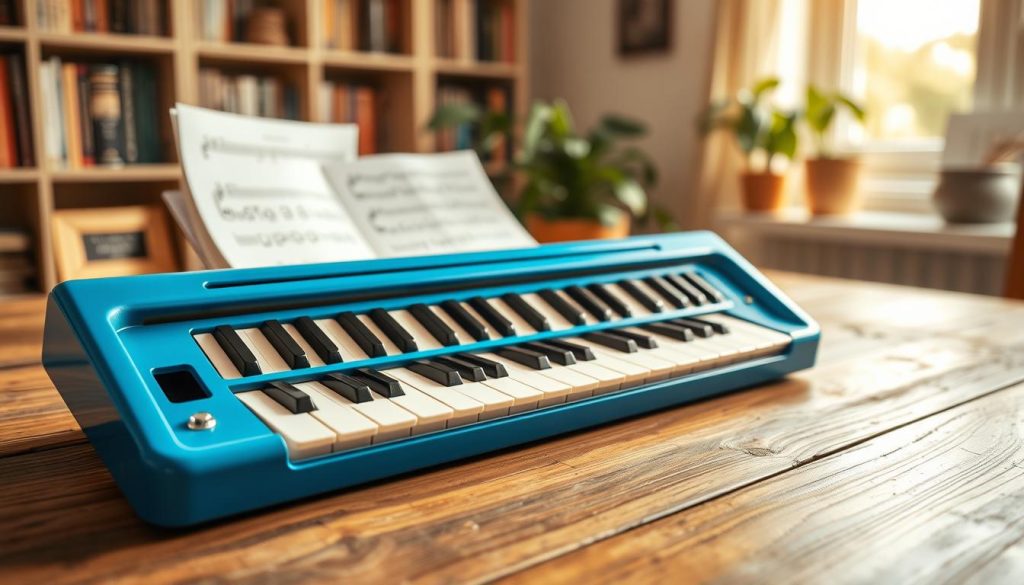
Welcome to this clear and concise introduction to a compact instrument that has won over musicians around the world.
Simple in appearance, this instrument reveals a rich range of sounds, particularly the Hohner Piano 26 model, which has acoustic openings on the back of the keyboard that provide unique projection.
Many artists have moved beyond its image as a toy and use the melodica in professional recordings. Its soprano timbre works equally well for solos and ensembles and suits blues as well as other styles.
Breathing remains the foundation: mastering your breath changes the way you approach the instrument and enriches its sound.
If you are looking for a practical starting point, consult a first lesson that explains playing positions and introduces the equipment. The techniques learned here will help anyone who wants to play for pleasure or on stage.
Understanding the Instrument’s Fundamentals
The simplicity of the melodica conceals surprising possibilities for serious musicians.
Size and keyboard: choosing between 32 and 37 keys changes the range and the way you write your music. Pianists adapt quickly to the keyboard, but the keys require a different touch.
Holding and breathing: holding the melodica correctly protects your hands and improves the sound. A flexible tube lets you set the instrument down and practice for long periods without fatigue.
Artists such as Makoto Nomura have elevated the melodica to the status of a professional instrument. Augustus Pablo, meanwhile, established the instrument in dub reggae.
- Finger coordination and breath control determine the quality of the notes.
- Different types and prices affect airtightness and tuning accuracy.
- Mouthpiece or tube: choose according to your comfort and style.
| Feature | 32 keys | 37 keys |
|---|---|---|
| Range | Compact, ideal for beginners | Wider, better suited to arrangements |
| Portability | Very lightweight | Slightly bulkier |
| Common use | Practice, rehearsals | Studio, stage |
To explore the educational side in greater depth, consult a teaching resource portfolio that will guide you through choosing and learning the instrument.
How to Play Melodica: Essential Techniques for Beginners
Hand position affects note clarity and learning speed. The first rule is simple: keep your hands relaxed. Tension restricts finger movement and alters the sound.
Position: place your thumb beneath the instrument and let your other fingers curve naturally over the keys. If you come from a piano background, adjust your wrist angle to avoid tension.
Hand Positioning
Practice slowly, at a snail’s pace, to develop muscle memory. I have seen beginners struggle with the keys; patience pays off.
Using the Keyboard
Place your fingers near the edges of the keys for better control. Using a mouthpiece often provides greater expressiveness than using a tube.
- Relaxed hands produce a better sound.
- The Yamaha P37D and Suzuki M-37C are excellent models for improving your skills.
- Watch videos to correct the way you hold the instrument and reproduce the movements.
| Area | Advice | Result |
|---|---|---|
| Hand flexibility | Relaxation and brief stretches | Clearer sound |
| Learning speed | Slow, regular practice | Reliable muscle memory |
| Expressive control | Mouthpiece rather than tube | Better note dynamics |
Mastering Posture and Breath
A stable posture immediately improves sound quality and gives the musician greater breathing freedom. Stand or sit upright with your shoulders relaxed, without rounding your back.
Place the base of the instrument in your left hand for a secure melodica hold. Your right hand remains free to move across the keys and form chords.
Breath Control
Breathe from the diaphragm. A steady airflow produces stable notes and a professional sound.
If you use a tube, keep your torso upright so that you can breathe deeply. With a mouthpiece, vary the attack of your breath to change the timbre.
- Coordination: synchronize your fingers and breath to achieve quick articulation.
- Expression: for blues, lift a key slightly with your finger to create a bending effect.
- Endurance: good posture prevents tension and breathlessness.
| Element | Advice | Effect |
|---|---|---|
| Body position | Back straight, shoulders relaxed | Deep breathing, better projection |
| Holding the instrument | Left hand at the base | Right-hand agility on the keyboard |
| Breath control | Steady airflow, active diaphragm | Stable notes and controlled dynamics |
For a complete learning pathway, consult a teaching resource portfolio suited to the needs of students and teachers.
Advanced Techniques to Enrich Your Playing
Exploring sophisticated effects makes it possible to achieve a range of expression rarely associated with this instrument. These approaches give the sound more depth and open up new stylistic possibilities.
Note Bending
Bending adds a blues color similar to that of the harmonica. Slightly flex a key or modulate your breath to lower the pitch.
Vibrato Effects
To produce vibrato, move the instrument quickly or modulate your breath with your throat. This creates a warm, lively effect on sustained notes.
Using the Tongue
The tongue can produce precise staccato articulations, such as te-ke-te-ke. This is ideal for rhythmic phrases and percussive accents.
- Pressing several keys requires more breath; adjust it to maintain the volume.
- How deeply you press a key changes the attack and expression.
- Performing a theme such as “Speak Softly Love” demonstrates the instrument’s versatility and emotional impact.
| Effect | Action | Result |
|---|---|---|
| Bend | Flex the key or modulate the breath | Blues expression, sliding note |
| Vibrato | Movement or throat modulation | Warmer, vibrating sound |
| Tonguing | Short, staccato articulations | Rhythm and precision |
Hermeto Pascoal proved that this instrument was not limited to recreational use. To discover other registers and blues sounds, also consult blues musical instruments.
Conclusion
From the street to the studio, the melodica confirms its status as a serious instrument, appreciated by many musicians around the world.
By working on the points covered in this guide, you can take your melodica playing to a professional level. Consistency and curiosity shape the finest notes.
Share your ideas and recordings to show that the melodica fits in everywhere. To explore a practical aspect in greater depth, also consult the advice on alternate fingerings.
Persevere: the way you approach your practice will determine your progress. Keep exploring and loving music.