
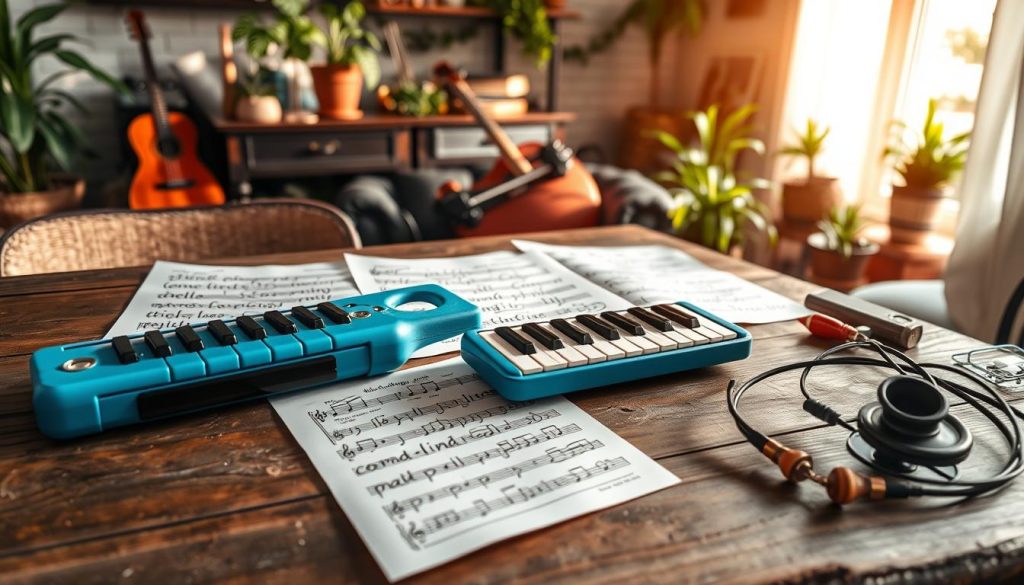
Manu Pilas made this song famous through the Netflix series Money Heist. This article offers a clear approach to learning the melody on the melodica, suitable for beginners and experienced musicians alike.
We explain the main notes, the position of each hand, and how to simplify the sheet music. Manu Pilas’s original version remains a reference, but a simplified version will help you progress quickly.
We also explain how to transfer these same instructions to a piano or keyboard. An explanatory video demonstrates hand positioning and makes it easier to develop the correct movement from the very first practice sessions.
By reading this article, you will learn which notes to prioritize and how to organize your practice sessions.
Understanding the basics of playing Bella Ciao on the melodica: notes and tips
Starting with a clear method makes this popular piece easier to learn. The OKTAV website offers sheet music classified at level 26, ideal for a beginner pianist.
This article summarizes the essential steps. Begin by practicing the main notes on your keyboard. This applies equally to an acoustic piano and a portable instrument.
Hand coordination requires progressive practice. Follow a simple method: the right hand plays the melody, while the left hand plays the accompaniment. Proceed slowly and repeat short passages.
The accompanying video shows how each hand moves across the keyboard. Choosing the right version prevents unnecessary difficulties and helps the pianist gain confidence.
- Start with short phrases.
- Take a breath between repetitions.
- Adjust the speed to your level.
Preparing your instrument and posture
Before touching the keyboard, take a moment to adjust your instrument and prepare your body. A properly adjusted instrument produces clearer notes and improves the accuracy of each hand.

Adjusting the melodica
Check the tuning and responsiveness of the keys. On a piano or melodica, make sure the keys respond without sticking.
If a sound lacks clarity, clean the contacts and check the mouthpiece. Simple adjustments improve your performance of the sheet music and prevent bad habits from developing.
The importance of posture
Adopt a stable seated position. Keeping your torso upright gives both your right hand and your left hand complete freedom of movement.
The demonstration video shows that physical comfort affects the fluidity of note sequences.
- Relaxed shoulders.
- A flexible wrist over the keys.
- A comfortable distance between you and the keyboard.
Analyzing the musical structure and notes
Identifying the sections and the pickup clarifies the opening and transitions. The piece is divided into three distinct sections: measures 1 to 17, 18 to 25, and then measure 25 to the end.
The pickup begins halfway through the third beat. This incomplete measure establishes a lively rhythm from the very first notes.
Understanding the pickup and rhythm
Each hand must be ready from the first attack. The right hand often carries the melody, while the left hand supports the harmony.
Looking at the sheet music reveals the balance between the voices. The transition from the first to the second section requires precise repositioning on the keys.
- Structure: three sections with a pickup one-third of the way through the third beat.
- Hand preparation: essential for keeping the measure.
- The video shows how the piano marks each beat and makes it easier to follow the pulse.
Mastering right-hand technical challenges
Mastering the right hand requires targeted exercises to overcome the most demanding passages. Begin slowly, then increase the speed in stages. This method preserves accuracy and control.
Handling the black keys
Passages involving black keys are often challenging, especially in the second section of Bella Ciao. Isolate these measures and play them repeatedly.
Practice the transition between the white keys and the black keys while keeping your wrist flexible. Repeat until the sequences feel natural.
Using fingerings
Choose consistent fingerings and write them on your sheet music. Consistent fingering prevents hesitation.
- Mark every difficult passage.
- Use the same finger numbers in every repetition.
- Adjust them if necessary, but test several options.
Practicing eighth notes
Controlling the eighth notes is essential for keeping time. Counting aloud is an effective exercise.
The right hand must remain precise, while the left hand supports the harmony. This ensures that the notes remain even.
“Measured repetition makes the difference between a hesitant passage and a flowing phrase.”
| Problem | Exercise | Duration | Expected result |
|---|---|---|---|
| Transitions between black and white keys | Slow eight-measure loop | 10 min/day | Greater fluidity |
| Inconsistent fingerings | Write down and repeat the fingering | 5 to 8 min per passage | Accuracy and muscle memory |
| Uneven eighth notes | Counting aloud with a metronome | 15 min/session | Steady rhythm |
Coordinating the left and right hands
Synchronizing your movements is the real challenge when performing Bella Ciao on a keyboard or piano. Begin by practicing each hand separately.
The left hand must provide a steady rhythmic accompaniment. Practice simple patterns and repeat them until they become automatic.
The right hand focuses on the melody and notes. Isolate passages involving the black keys and master them before adding the accompaniment.
Once each hand is comfortable, combine them slowly. Play at a reduced tempo and increase the speed in stages.
- Separate practice: 5 to 10 minutes per hand.
- Progressive integration: begin with two measures.
- Daily routine: 15 to 20 minutes to develop independence.
For simplified sheet music and other resources, see an adapted version here: simplified sheet music.
Tip: regular repetition transforms a hesitant accompaniment into confident, musical support.
Tips for performing the melody with emotion
To convey the soul of the melody, pay close attention to every attack. The right hand should play the notes with slightly more intensity than the left hand. This contrast creates depth and highlights the main line.
Begin each phrase with a clear intention. Respect the timing and rhythm of each section so that the listener immediately understands the musical direction.
Work on your pressure on the keys: slightly varying the force changes the tone and expression. The left hand should remain understated, providing support without becoming intrusive.
Do not hesitate to shape each measure dynamically. Even a little well-placed rubato can transform a simple piece into a personal performance. Preserve the structure while allowing your sensitivity to speak.
To find arrangement ideas and discover other approaches, explore a jazz arrangement that can inspire your choices on piano and keyboard.
“Expression is born from a detail chosen with conviction.”
Conclusion
Finally, adopt a simple routine that reinforces your musical skills. By following the steps in this article, you have clear tools for progressing with confidence.
Refer regularly to the sheet music and accompanying video to refine your technique and correct your fingerings. Return to a slower version if necessary.
Every pianist progresses at their own pace. This method provides a solid foundation for tackling other pieces and expanding your repertoire.
A little perseverance is all it takes to master this iconic tune and share your passion. To go further, download a piano guide that complements the method presented here.