

Discover a free-reed instrument that combines simplicity with rich tones. Compact and lightweight, this instrument is appealing because it is easy to handle. Its mechanism is similar to that of the harmonica, and it remains accessible to beginners.
Its keyboard is identical to that of a piano or organ, making the transition easier for anyone already familiar with these instruments. This structure allows rapid progress and makes learning more motivating.
To go further, read our comprehensive practical guide to Melodica Notes: Understand the Keyboard Quickly and discover why this instrument can transform the way you make music.
Understanding How the Melodica Works
Its operation relies on a simple interaction between breath, valves, and keys.
Anatomy of the Instrument
The body is generally made of plastic or metal and contains free reeds. When air passes through, these reeds vibrate and produce sound.
Valves open when a key is pressed, directing air toward the corresponding reed. Depending on the model, the blowing tube changes how the instrument is held and affects its sound quality.
The Different Models
Models vary in range: two octaves (26), two and a half octaves (32), three octaves (37), and three and a half octaves (44). The choice depends on the foundation desired for learning or advanced playing.
- Button versions are also available and offer another way to play.
- Hohner laid the groundwork as early as 1908 with the Hohnerette, a precursor to modern models.
- To compare the different types and their uses, read a historical overview and a comparison of models.
Melodica Notes: Understand the Keyboard Quickly
A stable right-hand position makes it easier to play chords and simple melodies.
Keep your right hand relaxed, with the fingers slightly curved. This helps maintain precise contact with the keys and improves sound quality.
The pressure applied to each key affects accuracy and dynamics. By varying your touch, you can play crisp notes or softer passages.
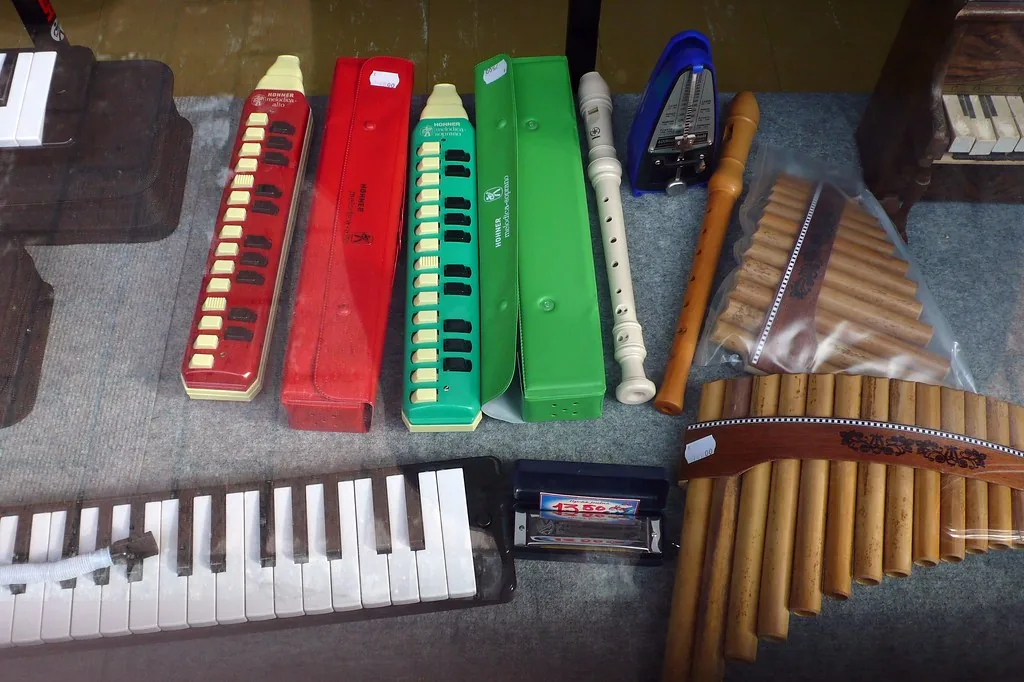
Using the blowing tube frees both hands. You can therefore form rich chords as you would on a piano and explore several octaves.
- Keep your fingers curved to prevent your hands from striking the body of the instrument.
- Button models offer a suitable solution for certain playing styles.
- Augustus Pablo demonstrated how this instrument could be incorporated into reggae to enrich its chords.
| Aspect | Advice | Result |
|---|---|---|
| Right-hand position | Curved fingers, relaxed palm | Fluid, precise playing |
| Pressure on the key | Control the force of your touch | Better sound quality |
| Using the tube | Allows both hands to be used | Richer chords and textures |
To practise, download a dedicated app and follow targeted exercises: practice app.
Playing Techniques and Hand Coordination
Adopting a stable posture makes all the difference when coordinating your hands and breath.
Posture and Breath
The left hand steadies the body of the instrument while the right hand plays the keys.
Keep your fingers flexible and your palm relaxed. A steady airflow produces clearer sounds.
Using the Blowing Tube
Placing the instrument on a table and using the tube frees both hands.
This allows you to play two-handed chords and melodies and explore several octaves without restriction.
Mastering Chords
Start with major and minor triads. Practise the transitions slowly.
Regularly practising scales across several octaves helps you recognize chord types and improve accuracy.
- Coordination: synchronize your breath with your keystrokes.
- Articulation: alternate between staccato and legato to enrich your playing.
- Exercises: follow suitable exercises to improve.
| Technique | Action | Objective |
|---|---|---|
| Posture | Steady left hand, relaxed fingers | Support and comfort |
| Breath | Steady airflow through the tube | Consistent sound |
| Chords | Practise triads and inversions | Rich texture |
Maintenance and Adjustments for Optimal Sound Quality
Regular maintenance is essential to ensure consistent sound reproduction.
Cleaning: rinse the tube with a solution of water and vinegar after each session. Clean the mouthpieces with warm, soapy water to prevent bacterial growth.

Storage: keep the instrument in a dry place, away from moisture. This protects the reeds and internal mechanism and preserves sound quality.
Adjustments and Repairs
A technician can perform complex adjustments, such as repairing air leaks or tuning the reeds. For models spanning two or more octaves, annual disassembly may be necessary to disinfect and lubricate the parts.
“The cleanliness of the air passages directly affects reed vibration and therefore sound quality.”
- Learn the basic maintenance steps: they are part of the learning process and extend the life of your model.
- Condensation affects pitch and tuning; wipe the air passages after use.
- The Melodica Festival, in Cologne or New York, highlights the importance of this maintenance for acoustic performance.
Conclusion
, Mastering this instrument requires structured practice and attentive listening.
With regular exercises, progress becomes clearer. Coordinating both hands and controlling the airflow remain essential for playing chords and melodies with finesse.
Whether it is a keyboard or button model, this instrument offers sound quality similar to that of a piano in a compact format. Simple maintenance preserves this quality and extends the life of the body and reeds.
Whether you are working on minor triads or scales across several octaves, practice makes playing much easier. In short, this small wind instrument can be a genuine tool for musical expression.